
Key Takeaways
- Five KPIs — client retention, caregiver turnover, hours per client, revenue per billable hour, and referral conversion — predict cash flow and operational health months before problems show up in revenue
- Caregiver turnover at the industry average of 65–75% costs $60,000–100,000 per year in hidden expenses for a 20-person roster; agencies under 50% are exceptional
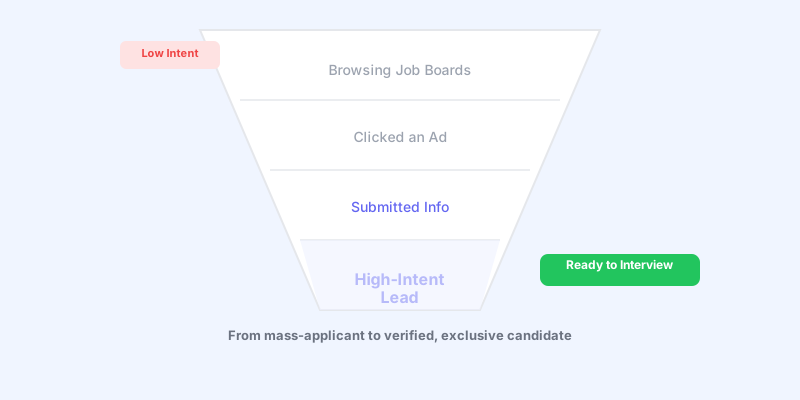
- Referral conversion rate by source reveals which acquisition channels actually pay — word-of-mouth and discharge planner referrals typically convert at 60–80%, job board leads at 10–25%
- A simple monthly spreadsheet is all you need; plot trends over 3–6 months rather than reacting to individual month variances
Home care agencies live and die by operational efficiency. A client in the system is different from a client retained long-term. A caregiver hired is different from a caregiver who makes it past 90 days. A referral source is different from a referral source that converts at 70% versus 15%.
The agencies with the tightest margins and most stable schedules are tracking five metrics consistently. These KPIs sit at the intersection of client satisfaction, caregiver stability, and cash flow. They predict problems three months before they show up in revenue.
The Five Core KPIs
- Client retention rate — % of clients active for 90+ days after onboarding
- Caregiver turnover rate — % of caregivers separated annually vs. average roster size
- Hours per client (average) — monthly billable hours divided by active client count
- Revenue per billable hour — gross revenue divided by total billable hours delivered
- Referral conversion rate — qualified referrals divided by clients actually assigned care
KPI 1: Client Retention Rate (90-Day and 12-Month)
A client who lasts 90 days has a 75%+ probability of lasting a year or more. A client who leaves before 90 days is usually signaling a problem: caregiver fit, scheduling mismatch, expectation misalignment, or quality issue. Tracking 90-day retention tells you whether your onboarding and matching process is working.
How to calculate: Take all clients who started care in a given month. Track how many are still active at day 90. Your 90-day retention rate = (clients active at day 90 / clients who started that month) × 100.
Industry benchmark: 70–75% is typical. Agencies running 85%+ are systematically better at onboarding or caregiver matching.
What it tells you: If your 90-day retention is dropping, the problem is in first-month operations — caregiver fit, communication, or schedule reliability. If it's steady but low (65%–70%), your onboarding process needs redesign. If it climbs over time, your sales process is improving but quality assurance is struggling.
Where to look if it's low:
- Exit interview data — ask departing clients why. Track reasons consistently (bad caregiver fit, scheduling, cost, found alternative, resolved need).
- First-contact experience — is your initial assessment thorough? Are you matching the right caregiver for the client's care level?
- Week 1–3 follow-up — do you check in? Many failures happen in the first two weeks when a client realizes the reality doesn't match their expectation.
KPI 2: Caregiver Turnover Rate (Annual Turnover %)
Caregiver turnover is the single biggest cost lever in home care operations. Each departure costs $3,000–5,000 in recruiting, onboarding, and lost billing hours. A 70% annual turnover rate (industry average) means you're replacing your entire team once a year, generating $60,000–100,000 in hidden annual costs for a 20-caregiver roster.
How to calculate: (Number of caregivers separated in the year / average roster size during that year) × 100.
Example: You had an average of 18 caregivers on roster throughout the year. 13 caregivers left. Turnover rate = (13 / 18) × 100 = 72.2%.
Industry benchmark: 65–75% is typical. Home care is historically high-turnover. Agencies running 50% or below are exceptional.
What it tells you: Turnover is a lagging indicator of culture, compensation, scheduling, and hiring quality. Trending up suggests onboarding problems, schedule instability, or compensation misalignment. Trending down suggests improvements in any of those areas.
Break it down further by first-90-day turnover vs. long-term: If you're losing people in the first 90 days, your hiring, onboarding, or job match is weak. If you're losing people after 90 days, your retention culture or advancement path is the issue.
KPI 3: Average Hours Per Active Client (Monthly)
This metric tells you whether you're serving clients the right amount or over-serving and limiting your capacity. It also tells you whether your pricing or care plans are attracting the right types of clients.
How to calculate: Sum all billable hours delivered to all active clients in a month. Divide by the number of active clients that month.
Example: In March, you delivered 4,200 billable hours across 60 active clients. Average = 4,200 / 60 = 70 hours per client per month.
Industry context: Typical range is 40–120 hours per month depending on whether you focus on light housekeeping (40–60 hrs), personal care (60–90 hrs), or intensive medical/live-in (100–160+ hrs).
What it tells you:
- If trending down, your marketing may be attracting clients who need less care, or existing clients are reducing hours (early signal of dissatisfaction).
- If trending up, you're either adding higher-need clients (good if your operations can support it) or existing clients are increasing hours (sign of satisfaction and trust).
- Combined with revenue per hour, it tells you whether your pricing structure is aligned with your service level.
KPI 4: Revenue Per Billable Hour
This is your operational efficiency metric. It's gross revenue divided by actual hours delivered to clients. The gap between your billed rate and your revenue per billable hour shows your cost structure, caregiver wage overhead, and operational friction.
How to calculate: Gross monthly revenue / total billable hours delivered that month.
Example: March revenue $52,500 / 4,200 billable hours = $12.50 revenue per hour.
Context: If you bill clients at $20/hour and your revenue per hour is $12.50, that $7.50 covers caregiver wages (typically $9–13/hour), mileage, insurance, admin overhead, and profit. That's a typical 50–60% cost of goods ratio.
What it tells you:
- Trending down suggests either wage inflation (paying caregivers more), pricing issues (clients negotiating lower rates), or operational inefficiency (underutilized caregivers, long travel times).
- If too low relative to your billing rate, you're overstaffed, over-mileage-ing, or under-pricing.
- Comparing month-to-month tells you whether you're getting more efficient (good) or less (problem to solve).
Use it to: Set pricing for new clients, evaluate which service types are most profitable, identify whether you need to negotiate caregiver schedules or routes.
KPI 5: Referral Conversion Rate (By Source)
Not all referrals are equal. A discharge planner referral might convert at 75%. An online lead might convert at 10%. Your referral conversion rate tells you which of your customer acquisition channels are actually producing — and which are consuming budget or time without results.
How to calculate: (Clients who received care assignments from referral source / total referrals from that source) × 100. Track by source: discharge planners, hospitals, online leads, social media, word-of-mouth, etc.
Example: Your discharge planner at County Hospital sent 12 referrals in Q1. 9 of them resulted in assigned care. Conversion = (9 / 12) × 100 = 75%.
Industry context: Word-of-mouth and discharge planner referrals typically convert 60–80%. Job board leads convert 10–25%. Online form fills convert 5–20%. Direct inquiries (phone call, existing client referral) convert 40–60%.
What it tells you:
- High-converting sources (70%+) are worth investing time and relationship-building in. Discharge planner relationships are high-leverage.
- Low-converting sources (below 20%) are worth auditing. Are your lead profiles wrong for your service? Is your sales process weak? Is the source unqualified?
- Comparing sources helps you allocate your time and budget. A referral source converting at 15% but producing high-hours clients may be more valuable than one converting at 60% but producing low-hours clients.
Drill deeper: Also track average client value (hours per month × rate × months retained) by source. The best source isn't highest conversion rate — it's highest total revenue per referral.
Building a Tracking System
You don't need expensive software. A simple spreadsheet updated monthly captures these five metrics:
Monthly tracking sheet:
- Column A: Month
- Column B: New clients signed
- Column C: Clients retained at 90+ days (from 90 days prior)
- Column D: 90-day retention %
- Column E: Caregivers at month-start
- Column F: Caregivers at month-end
- Column G: Caregivers separated
- Column H: Average roster size
- Column I: Annualized turnover % (G / H × 100)
- Column J: Billable hours delivered
- Column K: Active clients
- Column L: Hours per client (J / K)
- Column M: Gross revenue
- Column N: Revenue per hour (M / J)
- Column O: Referrals by source (create sub-columns)
- Column P: Conversions by source
- Column Q: Conversion rate %
Update this every month. Plot the metrics on a simple line chart. Look for trends, not individual months — a single month variance means nothing. Trends over 3–6 months reveal whether your business is getting stronger or weaker.
What Happens When You Track These
Agencies that track these five metrics consistently make better decisions. They can see that caregiver turnover is trending up and fix it before losing 30% of their roster. They notice referral conversion from one source dropping and investigate. They see that their revenue per hour is flat while client hours are up and realize they need a pricing increase.
Most agencies don't track these at all. They know they're making money or losing money, but they can't see where the leverage points are. When something goes wrong, they have no data — just a feeling that something is off.
Start tracking these five metrics this month. Put them in a spreadsheet. Don't wait for perfect data — approximate numbers are fine. By month three you'll be able to predict problems. By month six you'll have the data to make strategic decisions about pricing, caregiver strategy, and which customer acquisition channels to invest in.
If you're looking to improve your client acquisition efficiency, try Hesed's exclusive leads at $10 each — start with 5 free leads and track your referral conversion rate against the numbers above. The best way to improve KPI 5 is testing channels with clear attribution.
Getting leads shouldn't be this hard.
5 free leads to start. $10/lead after. Card required to activate delivery. No contracts.
Start Free →