
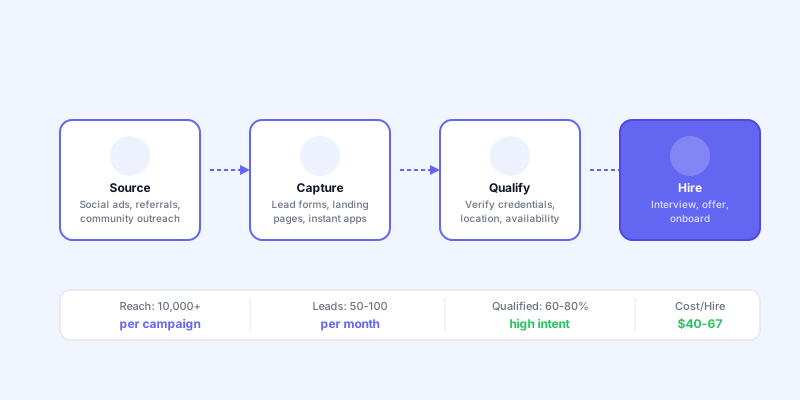
Home care agencies serving Orthodox and observant Jewish families operate under constraints most competitors do not think about. Shabbat coverage is a weekly staffing puzzle. Passover and the High Holidays are acute demand spikes. Kashrut-aware caregivers require an onboarding conversation that generic agencies skip entirely. The payoff is that this niche is nearly impossible for non-specialized agencies to serve — which is exactly why agencies that build the right roster win it outright.
Key Takeaways
- Shabbat coverage requires two caregiver profiles — observant (off Friday night to Saturday night) and non-observant (willing to work that window)
- Pesach week demand spikes 30–50% in communities with large observant populations
- Recruit through local shuls, JFS chapters, and Chabad networks — not generic job boards
- Kashrut-awareness can be trained in a 20-minute orientation, but it must be documented so non-Jewish caregivers do not make errors in client kitchens
- Holiday coverage rates run 1.5x standard on Shabbat and yom tov — factor into pricing up front, not as emergency surcharge
The Shabbat Coverage Problem, Stated Clearly
From Friday sunset to Saturday sunset, observant Jewish caregivers generally cannot work. They will not drive, answer phones, or operate medical equipment during that window. That is a 25-hour block, every single week, where your observant staff is unavailable.
The clients who most need specifically Jewish home care — Orthodox elderly adults living in Orthodox communities — also have the highest demand for care exactly during that window. Families want companionship during Shabbat meals. They want someone in the home while they walk to shul. They want continuity for a parent who keeps kosher and would not be comfortable with a caregiver who does not understand the rules.
Agencies that try to solve this with a single homogeneous caregiver pool hit a wall fast. The solution is a two-track roster by design.
Build Two Caregiver Profiles, Not One
Track A: observant caregivers who work Sunday through Friday morning and are off for Shabbat. These caregivers are your weekday backbone. They understand kashrut intuitively, they can attend family simchas, they can cover yom tov daytime when appropriate. They are often the caregivers families request by name. Recruit them through community channels: local shuls, Jewish Federation, community center bulletin boards, Chabad networks, and Orthodox Jewish mom Facebook groups in your service area.
Track B: non-observant caregivers specifically trained to work Shabbat shifts. These may be Reform or secular Jewish caregivers, Christian or Muslim caregivers, or any caregiver who has completed your kashrut-awareness and Shabbat-etiquette orientation. They are scheduled specifically for the Friday-sunset-to-Saturday-sunset window, because that is when they have the most availability and when your observant track cannot cover.
Pay Track B a Shabbat premium. The market for caregivers who will consistently work Friday evenings and Saturdays is smaller than the general caregiver pool, and rewarding them appropriately prevents them from drifting to agencies without that constraint.
Passover Is a 10-Day Staffing Sprint, Plan for It in February
Pesach compresses three staffing pressures into a single week:
- Demand spike. Adult children traveling in for seders need extra daytime coverage. Families cleaning for Pesach need help for parents with mobility or cognitive issues. First and last days are yom tov with full Shabbat-level restrictions for observant families.
- Kitchen complexity. The kitchen is kashered, then flipped to Pesach dishes, then flipped back. Caregivers preparing food during the week need clear written instructions for what is permitted where. One mistake can render a family's kitchen unusable for the rest of the holiday.
- Caregiver availability dips. Observant caregivers take the holiday off. Non-Jewish caregivers may be off for Easter (which often overlaps). Your labor pool shrinks exactly when demand peaks.
Agencies that scramble for Pesach coverage in the week before the holiday are routinely short-staffed. The agencies that do it well start in February — building out the schedule, identifying which clients need extra hours, and locking in coverage eight weeks in advance. Every year. The timeline is predictable; the scramble is not.
Kashrut-Awareness Training That Actually Sticks
Most non-Jewish caregivers do not arrive knowing kashrut. Most do not need to become experts. What they need is a 20-minute orientation plus a printed reference they can check in the moment.
The orientation covers: separate dishes for meat and dairy, separate utensils, meat and dairy not eaten together or prepared on the same surfaces, waiting period after meat before dairy, and what to do when in doubt (do not serve, call the family). Cover hechshers briefly — how to recognize a kosher certification mark on packaged food. Explain that some families are strict about bishul akum (food cooked without Jewish involvement) and some are not, and that this is client-specific.
The printed reference is the key. A single-page laminated card taped inside the pantry door of each client's home, with that family's specific instructions: which dishes are meat, which are dairy, where utensils live, what to do with leftovers, who to call with questions. New caregivers do not have to remember everything. They have to know to check the card.
Families appreciate this. It signals that your agency takes their religious practice seriously enough to systematize it. Most agencies do not.
Where to Recruit the Right Caregivers
Generic job boards — Indeed, ZipRecruiter — do not surface the caregivers you need for this niche. The candidates who are already observant, who already understand Jewish homes, or who are specifically interested in working with Jewish clients come from community channels.
The high-yield recruiting sources:
- Jewish Family Service chapters. JFS organizations in most major Jewish population centers run caregiver registries or know community members looking for work. Introduce your agency to the JFS social worker handling elderly services. Maintain the relationship.
- Local shuls and synagogue bulletins. Many Orthodox shuls have weekly email bulletins that include community employment postings. A recurring quarterly mention is more effective than a one-off ad.
- Orthodox mothers Facebook and WhatsApp groups. These hyperlocal groups surface candidates who are looking for flexible work aligned with their own religious practice. Respect group rules; do not spam.
- Nursing programs serving Jewish communities. Touro College of Osteopathic Medicine, local community college nursing programs in high-density Jewish zip codes. Graduates often want placements in communities they grew up in.
- Chabad networks. Chabad houses often connect community members to employment opportunities, especially for women returning to the workforce or seeking flexible hours.
Rate Structure: Price the Constraints In
Agencies that charge a flat rate regardless of coverage time lose money on Shabbat and holiday shifts and make it up on weekday shifts. That creates resentment in both directions — caregivers working premium times feel underpaid, families with weekday-heavy needs feel overcharged.
The cleaner structure: a standard weekday rate, a Shabbat rate at 1.25–1.5x, and a yom tov rate at 1.5–2x. Disclose this in the initial client conversation. Observant families understand the structure immediately — they have been paying holiday premiums to kosher caterers, shomer shabbos drivers, and Shabbos goys their whole lives. What frustrates them is when an agency quietly loses money on holiday coverage and then pulls back from the community when the financials do not work.
This Niche Is Defensible
Most home care agencies cannot serve Orthodox Jewish families well. Generic caregiver training does not cover kashrut. Generic scheduling does not accommodate Shabbat. Generic recruiting does not reach observant candidates. The skills and relationships an agency builds to do this work are genuinely hard for competitors to copy on short notice.
What that means: the agencies that invest in this specialization — the training, the community relationships, the rate structure, the two-track caregiver roster — end up owning the referral network. Rabbis refer to them. JFS social workers refer to them. Families refer to them. The pipeline becomes self-sustaining.
If you run a home care agency in a market with a significant observant Jewish population and you want to build out this capability, start with the community relationships. Introduce yourself to the JFS caregiver liaison. Ask to post in one or two shul bulletins. Hire one observant caregiver before you need them, and one Shabbat-willing caregiver before you need them. The roster grows from there.
If you want to accelerate the sourcing side, Hesed Leads delivers exclusive caregiver and CNA leads at $10 each across Colorado, New York, California, Florida, and other states — including targeting for candidates in Jewish community zip codes. No monthly minimum, no contracts. Turn it on when you are hiring, pause when you are staffed.
Getting leads shouldn't be this hard.
5 free leads to start. $10/lead after. Card required to activate delivery. No contracts.
Start Free →