
Key Takeaways
- Home care aide employment is projected to grow 21–25% through 2032
- Job board cost per hire ($400–700) is rising while candidate quality is declining
- Social media ads reach caregivers where they actually spend time (Facebook/Instagram, not Indeed)
- Speed of follow-up matters more than most agencies realize — text within an hour, not a call in 48 hours
- Hire for retention: honest onboarding about schedule, clients, and pay reduces 90-day churn
The State of CNA Recruiting in 2026
The U.S. Bureau of Labor Statistics projects home care aide employment to grow 21–25% through 2032 — one of the fastest-growing occupations in the economy. Demand is rising. Labor supply is constrained. And the agencies operating in this environment on job board default settings are finding it harder and more expensive to hire each year.
The agencies filling their rosters consistently aren't spending more. They're spending differently. Here's what's actually working.
What Doesn't Work (Anymore)
Before the strategies that work, it's worth naming what's consuming budget without producing results for most agencies.
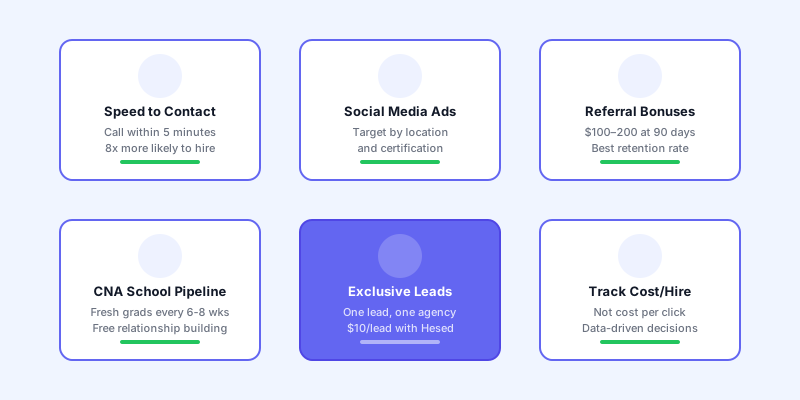
Generic job postings on Indeed and ZipRecruiter. The job board model was built for professional roles with resume-based applicants. For caregiving recruitment, you're paying $15–30 per click to compete with every other agency in your market for candidates who are simultaneously comparing offers from all of you. Cost per hire averages $400–700. Retention of job board hires is below the industry average.
Pay rate competition. Trying to out-price competitors on hourly rate is a race to the margin. Candidates who chose you primarily for $0.50/hour more will leave for the next agency offering $0.50/hour more. Pay matters — you need to be in the competitive range — but it's not a sustainable differentiator.
Waiting for applicants. Passive "post and pray" recruiting assumes candidates will find you. In a tight labor market, the agencies winning are the ones reaching candidates rather than waiting for them.
Strategy 1: Go Where Caregivers Actually Are
The caregiver demographic — women aged 25–55, concentrated in specific zip codes, often in communities with strong social networks — is more active on Facebook and Instagram than on job boards. Pew Research data consistently shows that job boards skew toward professional and college-educated job seekers, not the primary demographic for CNA roles.
Facebook and Instagram Lead Ads let you target that demographic directly: people who follow healthcare content, live in your service area, and fit the profile of a potential caregiver. The lead form opens inside the app — no job listing to compete with, no resume to upload, just a name and phone number submitted directly to your team.
The leads you get from a well-targeted social media campaign are people who responded to your specific ad. They haven't applied to six other agencies the same day. That distinction changes the entire recruiting conversation.
Strategy 2: Build a Referral Program That's Actively Promoted
Employee referrals are the highest-quality recruiting channel for home care. Referred candidates know what the job involves before they start. They have a social connection to your agency. And they don't want to disappoint the person who referred them — which translates to meaningfully better 90-day retention.
The program structure is secondary to promotion. A $150–200 bonus paid at 90 days is standard. What makes referral programs work is consistent promotion: a monthly text to all active caregivers, a reminder at new hire orientation, a mention during check-in calls. Most agencies have a referral program. Most caregivers couldn't name the terms without looking them up.
Strategy 3: Be First — Speed of Follow-Up Matters More Than You Think
Multiple studies of lead conversion in recruiting have found that the odds of making contact with a candidate drop significantly after the first five minutes. This is especially true for caregiving candidates, who are often deciding between multiple options and will commit to whoever engages them first in a substantive way.
Agencies that text first — rather than call — see higher response rates for initial outreach. A text saying "Hi [Name], I saw you're interested in caregiving work in [area] — I'm [recruiter] at [agency]. When's a good time to chat?" is less intimidating than an unknown phone call and easier to respond to on the candidate's schedule.
Fast, conversational follow-up converts leads at significantly higher rates than the formal recruiter call scheduled 48 hours out. If your team can't respond within an hour to new leads, that's worth addressing before anything else.
Strategy 4: Partner with CNA Schools
CNA certification programs produce new graduates every six to eight weeks. These graduates are actively looking for first placements and haven't posted resumes anywhere yet. A relationship with a program director — even an email and occasional check-in — can put your agency in front of those graduates before any job board does.
The investment is low. Most programs will post openings on their internal board at no cost. Some will invite you to career days or graduation events. A few will actively recommend specific agencies to graduates based on reputation and relationship. Get on that list.
Strategy 5: Hire for Retention, Not Just to Fill the Seat
The agencies with the lowest turnover rates are rigorous at the front end about candidate fit — not just skills, but schedule compatibility, transportation reliability, and motivation for caregiving work. A position filled with a genuinely good fit costs less long-term than a position filled fast with someone who leaves in six weeks.
This means being honest in recruiting about what the job involves. Variable schedules, client difficulty, physical demands — surfacing these during the interview rather than after 30 days produces better retention. Candidates who stay know what they signed up for.
It also means asking about motivation directly: "What draws you to caregiving work specifically?" Candidates with genuine answers — not just "I need a job" — consistently outperform those who chose caregiving by default.
Putting It Together
The agencies filling their rosters without overpaying in 2026 are combining channels: social media leads for high-intent passive candidates, referrals for pre-qualified word-of-mouth hires, school partnerships for new graduates, and fast follow-up that converts more of whatever leads they have.
Job boards haven't disappeared from the mix entirely — they can fill urgent single-position needs in competitive markets. But they're not the foundation. They're a backup.
If you want to add high-intent social media leads to your recruiting mix without managing the campaigns yourself, Hesed delivers exclusive leads at $10 each — billed daily, no monthly minimum. Turn delivery on when you're hiring, pause when you're fully staffed.
Getting leads shouldn't be this hard.
5 free leads to start. $10/lead after. Card required to activate delivery. No contracts.
Start Free →