
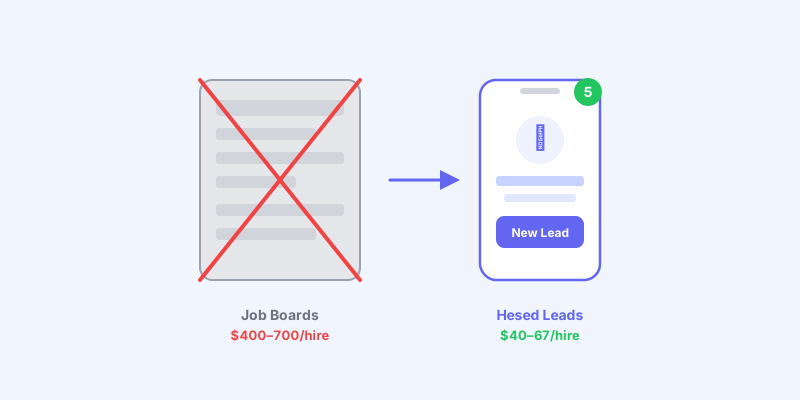
Home care agencies can hire CNAs for $40–100 per hire — up to 90% less than Indeed's $400–700 — by switching to social media lead generation, referral programs, and exclusive lead services. Each of these channels reaches candidates before they start mass-applying on job boards, producing higher-intent applicants at a fraction of the cost.
Key Takeaways
- Indeed costs $400–700 per CNA hire; alternatives cut that to $40–100
- Facebook Lead Ads reach candidates before they mass-apply on job boards
- Referral programs ($100–200 bonus at 90 days) have the highest retention of any channel
- Exclusive lead services deliver one candidate to one agency — no competing calls
- Track cost per hire, not cost per click, to evaluate any recruiting channel
Why Job Boards Are Breaking for Home Care Agencies
If you've posted a CNA position on Indeed in the last two years, you already know the pattern: dozens of applications, half of them don't answer the phone, a third aren't even local, and the ones who do show up for an interview have applied to six other places the same week.
The job board model was built for office jobs in 2005. It was never designed for caregiving recruitment. And yet the industry keeps paying for it — because it's the default, not because it works.
Here's what the math actually looks like. Indeed charges $15–30 per sponsored job click. That's not per applicant. That's per click — whether the person fills out an application, bounces in 10 seconds, or was a bot. ZipRecruiter runs $249–449 per month on standard plans, regardless of whether you hire anyone. When you factor in that the average home care agency needs to contact 20–40 job board applicants to extend one offer, the true cost per hire lands between $400 and $700. Often more.
There are better paths. Agencies that have moved off job boards as their primary channel are seeing cost-per-hire figures in the $40–$100 range. Here's what they're doing.
Social Media Lead Generation
Facebook and Instagram have something job boards don't: demographic and behavioral targeting. You can reach people who have already signaled interest in caregiving work — through the pages they follow, the content they engage with, and the life stage they're in.
Facebook Lead Ads, specifically, let candidates submit their name, phone number, and email directly inside Facebook without ever leaving the app. There's no job listing to compete with, no "Easy Apply" button that auto-applies to 50 jobs, and no anonymous resume in a pile.
The leads you get from a well-targeted Facebook campaign are people who responded to your specific ad, about your specific agency, in your specific market. That's a different quality of candidate than someone who searched "CNA jobs near me" and bulk-applied to everything in the results.
Running effective Facebook lead campaigns takes some skill — creative that converts, targeting that doesn't overspend, forms that qualify without scaring people off. But the unit economics are dramatically better than job boards when done right.
Referral Programs
Your existing CNAs know other CNAs. They work the same floor, attend the same trainings, and talk. A structured referral program — $100–200 bonus paid when a referred hire reaches 90 days — is one of the highest-ROI recruiting investments you can make.
Most agencies claim to have a referral program. Few actively promote it. Put it on a flyer in the break room, text it to your active caregivers monthly, and remind them every time they ask about a pay raise. Word-of-mouth hires typically have better retention than job board hires because they came with a built-in social connection to your team.
Local Community Outreach
CNA schools are graduating new CNAs every six to eight weeks. A visit to a local program — or even just an email to the program director — can get your agency in front of a cohort before they've posted a single resume anywhere. Some schools will post your open positions on their internal board for free.
Churches, community centers, and social services offices in your coverage area are also underused channels. Many caregivers come from tight-knit communities where trust travels through word of mouth, not job boards. Building relationships with community organizations puts you in that network.
Exclusive Lead Services
The third option is buying leads directly — but the word "leads" covers a wide range of quality.
Shared lead platforms sell the same candidate information to five or ten agencies simultaneously. You get the name, they get inundated with calls, and conversion rates suffer. It's a slightly cheaper version of the same job board problem.
Exclusive lead services work differently. One candidate goes to one agency. There's no competing with four other recruiters calling the same person at the same time.
At Hesed, we run targeted social media campaigns and deliver the resulting leads exclusively to a single agency in each market — at $10 per lead. The cost per hire (assuming a typical 4–7 leads-to-hire ratio) lands at $40–70. That's 80–90% cheaper than job boards, with higher-intent candidates who raised their hand specifically for caregiving work.
If you want the social media lead channel without building and managing campaigns yourself, that's what a managed service provides. You get the leads, not the ad management overhead.
Evaluating What's Actually Working
Whatever channel you use, track cost per hire — not cost per click, not cost per application. Many agencies optimize for the wrong metric. A channel with a $2 cost per application but a 2% conversion to hire is worse than a channel with a $15 cost per lead and a 25% conversion rate.
Pull 90 days of hires and ask: where did each person come from, and how much did it cost to get them there including staff time spent screening? That number will tell you more than any platform's self-reported metrics.
The Bottom Line
Indeed and ZipRecruiter aren't going anywhere, and they're not useless for every role. But treating them as the default — and accepting $400–700 per hire as the cost of doing business — is a choice. And it's a choice with increasingly good alternatives.
Social media lead generation, referral programs, community partnerships, and exclusive lead services each offer better cost-per-hire economics. The agencies winning on recruiting right now are using a combination of these rather than waiting for job boards to improve.
If you want to see what exclusive social media leads look like for your market, you can start delivery here. First leads typically arrive within 24–48 hours of setup.
Getting leads shouldn't be this hard.
5 free leads to start. $10/lead after. Card required to activate delivery. No contracts.
Start Free →