
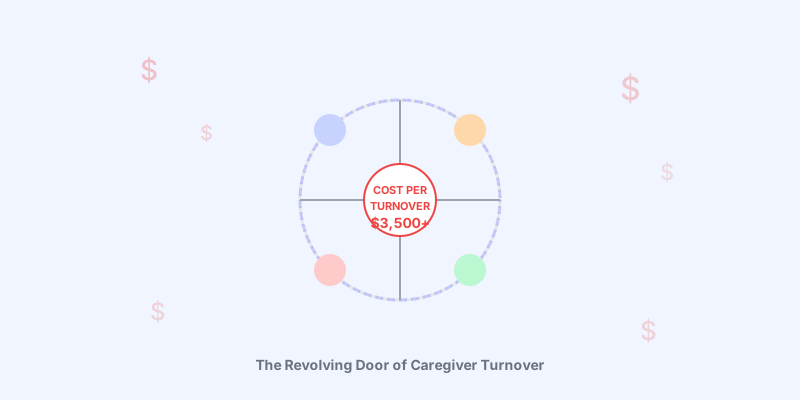
CNA turnover costs home care agencies $3,000–5,000 per departure, according to Home Care Pulse's annual benchmarking report. For an agency losing 20 CNAs per year, that's $60,000–100,000 in recruiting, onboarding, and lost billing costs — costs that rarely appear as a line item in the P&L but show up directly in margin and service quality.
Key Takeaways
- Each CNA departure costs $3,000–5,000 in recruiting, onboarding, and lost billing
- Industry turnover runs ~70% annually — but it's a variable cost, not a fixed one
- Job board hires churn faster because they applied to 10+ agencies simultaneously
- High-intent leads from social media produce better 90-day retention than job boards
- Track cost per hire by source and 90-day retention by source to find your best channel
The Industry Has a Retention Problem
According to Home Care Pulse's annual benchmarking report, caregiver turnover in the home care industry runs around 70% annually. That figure has been stubbornly high for years. Many agencies treat it as an immutable fact of the business — just the cost of being in home care.
But turnover isn't a fixed cost. It's a variable one, and the agencies that treat it as a problem to solve rather than a condition to accept consistently outperform their markets on revenue, client satisfaction, and caregiver quality.
The first step is knowing what turnover is actually costing you. Most agency owners underestimate the number significantly.
Breaking Down the True Cost of Losing One CNA
When a CNA leaves, the direct costs are visible: job board fees, background check, onboarding materials. But the full picture includes categories most agencies don't track.
Recruiting costs: Job board fees, social media ad spend, staff time screening applicants. At $15–30 per click on Indeed, filling a position often runs $300–600 in platform spend alone, before you factor in the four to eight hours a recruiter or office manager spends reviewing applications, calling candidates, and scheduling interviews.
Onboarding costs: Orientation time, training hours, benefits enrollment administration, and the ramp-up period where a new CNA is less efficient than an experienced one. For a role paying $16–18/hour, a 30-hour onboarding investment is $480–540 in direct labor, plus the supervisor time to oversee it.
Lost billable hours: The gap between when a CNA leaves and when a replacement is fully productive — typically two to four weeks — represents lost billing capacity. If that CNA was covering 30 hours per week at a $25/hour bill rate, two weeks of gap is $1,500 in revenue that doesn't exist.
Client disruption costs: Clients who experience caregiver turnover are more likely to churn. Continuity of care is one of the top reasons families choose and stay with an agency. A single departure can trigger a client loss that's worth far more than the recruiting cost alone.
Add it up, and the realistic cost of losing one CNA runs $3,000–5,000. Home Care Pulse's research has consistently put the figure in this range. For an agency that turns over 20 CNAs in a year, that's $60,000–100,000 in hidden costs that don't show up as a line item anywhere in the P&L.
Why Job Board Hires Churn Faster
Not all hires are created equal when it comes to retention. And the recruiting channel matters more than most agency owners realize.
Job board applicants — particularly on platforms like Indeed — are typically active job seekers who are applying broadly and simultaneously. They're comparing offers from multiple agencies, comparing hourly rates, and will accept the first acceptable offer they get. Their commitment to any one employer at the point of hire is low.
This isn't a character judgment. It's an information problem. The candidate who finds you through a job board doesn't know much about your agency beyond the job listing. They've applied to you the same way they've applied to eight others. There's no particular reason to prefer you over a competing offer that's slightly better on pay or schedule.
High-intent leads work differently. A candidate who saw your specific ad, learned about what your agency offers caregivers, and raised their hand specifically in response to that message — that person has already differentiated you from the field before they ever speak to your recruiter. They came to you, not to "a CNA job." That distinction matters at hire, and it shows up in retention data over the following 90 days.
The Recruiting-to-Retain Pipeline
Retention starts before the hire. The practices that produce long-tenured CNAs aren't just about what happens after someone joins — they begin with who you recruit and how you recruit them.
Source selection: Channels that produce higher-intent candidates produce better retention. Referrals from existing staff have the highest retention rates because the candidate came with social accountability — they know someone at your agency and don't want to let them down. Social media leads (targeted to people with caregiving interest) perform better than job boards for similar reasons.
Honest onboarding: Turnover spikes in the first 90 days when expectations don't match reality. Being explicit about schedule variability, client difficulty, mileage expectations, and pay structure — even when it's not your strongest selling point — produces better 90-day retention than overselling the role.
Early touchpoints: The agencies with the lowest turnover check in with new CNAs at day 3, day 14, and day 30. Not a performance review — a genuine "how's it going, what do you need, is anything surprising you." This catches mismatches before they become resignations.
Clear advancement path: CNAs who see a path to HHA certification, lead caregiver roles, or office positions stay longer. Even small structural signals — "after 90 days you're eligible for a pay review" — reduce early churn meaningfully.
The Math on Better Recruiting
If your current cost per hire is $500 on job boards and your 90-day retention rate is 60%, you're paying $500 for hires that have a 40% chance of being gone before you've recovered your onboarding investment.
If you shift to a channel where leads cost $10 each, your cost per hire (at 4–7 leads per hire) is $40–70, and your 90-day retention rate improves to 75% because candidates are higher-intent — the math changes dramatically. You're spending less per hire, and more of those hires are staying long enough to become assets to your operation.
The retention improvement doesn't have to be huge to matter. Going from 60% to 70% 90-day retention on 30 annual hires means eight fewer early departures per year. At $3,000–5,000 per departure, that's $24,000–40,000 back in the business.
What to Track Starting Now
If you're not already tracking these numbers, start this week:
- Cost per hire by source — total spend on channel divided by hires from that channel
- 90-day retention by source — what percent of hires from each channel are still employed at 90 days
- Time to fill — days from posting to first day of work
- Departure reason — exit interview data, even informal, categorized consistently
These four metrics will tell you more about where your recruiting problems actually live than any job board's analytics dashboard.
If you want to test a higher-intent recruiting channel and see what the 90-day numbers look like, Hesed delivers exclusive leads at $10 each, billed daily, with no monthly minimums. You can pause anytime.
Getting leads shouldn't be this hard.
5 free leads to start. $10/lead after. Card required to activate delivery. No contracts.
Start Free →