
Key Takeaways
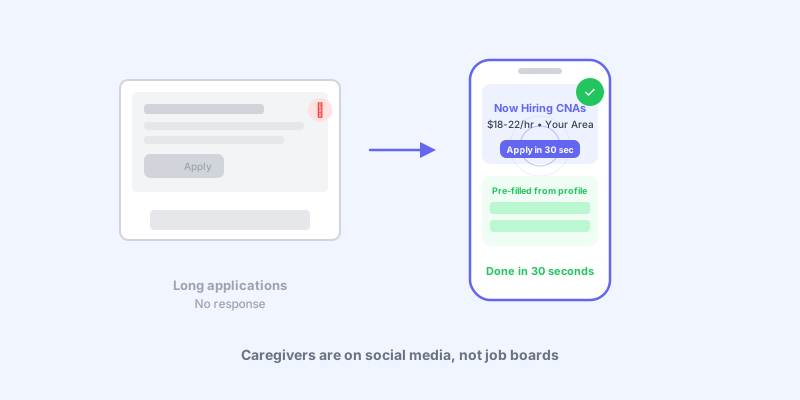
- Most potential caregivers are not on job boards — they're on Facebook and Instagram
- Job boards reach active seekers who are applying to 10+ agencies simultaneously
- Passive candidates (not yet job searching) often make better, longer-tenured hires
- The caregiver demographic (women 25–55) spends significantly more time on social media than job boards
- Social media ads reach people who would consider caregiving but haven't searched for it yet
The Job Board Assumption
The standard assumption in recruiting is that people looking for work go to job boards. Post where the candidates are, the logic goes, and the candidates will find you.
That assumption was reasonable in 2010. It's increasingly wrong in 2026 — and for caregiving roles, it was never fully accurate to begin with.
Who Job Boards Actually Reach
Job boards attract active job seekers: people who have decided to find a new job, opened a browser, and searched for openings. This is a real group. But it's not the whole market for caregiving labor, and it's arguably not the best part of it.
The typical CNA on Indeed is applying to multiple agencies simultaneously, comparing offers, and price-sensitive in ways that make retention harder. They've been on job boards before. They know how to play the application game. They'll accept the fastest offer with the best rate and move if a better one comes along six weeks later.
This isn't a character flaw. It's what the job board model produces: transactional behavior from candidates who are behaving transactionally because the platform invites it.
Where the Other Candidates Are
The people job boards miss are what recruiters call passive candidates — people who haven't started a job search yet, but who would respond if the right opportunity appeared in front of them.
For caregiving specifically, this pool is large. Consider the demographics:
- People currently working informal caregiving roles for family members or neighbors, not compensated
- People coming off other service-sector jobs (retail, hospitality) looking for more meaningful work
- Recent immigrants with caregiving experience from their home country, not yet fluent in job board navigation
- People who considered healthcare but couldn't afford nursing school and don't know CNA certification is an option
None of these people are on Indeed today. But many would respond positively to an ad that showed up on their Facebook feed, described caregiving work accurately, and made the application process easy.
The Social Media Behavior Gap
The caregiver demographic — predominantly women, often 25–55, concentrated in specific zip codes, often in communities with strong social ties — spends significantly more time on Facebook and Instagram than on job boards.
Pew Research consistently finds that Facebook usage skews toward 30–65 year olds, a demographic that overlaps heavily with the caregiver labor pool. Instagram reaches a slightly younger cohort in the 25–40 range. Job boards, by contrast, see heavier use among professionals and recent college graduates — not the primary audience for CNA roles.
This means there are more caregivers on Facebook at any given moment than on Indeed. The job board assumption sends your budget to the smaller pool.
The "I Didn't Know That Was an Option" Factor
Another group job boards consistently miss: people who would choose caregiving work if they knew about it, but haven't considered it because no one has ever put it in front of them.
CNA certification in many states takes four to six weeks and costs $500–1,500. For someone currently working retail or food service, that's an accessible path to more stable employment, more meaningful work, and in some markets, better pay. But they're not searching "CNA jobs" on Indeed because it hasn't occurred to them that caregiving is a viable path.
A targeted social media ad — reaching people who follow healthcare accounts, who are in the right age and location demographic, who have expressed interest in service-oriented work — can introduce that path. That's a candidate job boards cannot reach because the candidate hasn't self-identified as a job seeker yet.
Speed Isn't Everything
The argument for staying on job boards is usually speed. Post a job, get applicants the same day. That's real. But speed of application and quality of hire are often inversely correlated in home care.
The fastest applicants on job boards are frequently the most transient candidates — people actively cycling through agencies, comparing rates across multiple offers, and not particularly committed to staying. The passive candidate who sees a social media ad and submits their information for the first time comes with no competing offers and a cleaner slate.
What This Means for Your Recruiting Budget
If your caregiver recruiting budget is concentrated on job boards, you are reaching the smallest and most competitive slice of the available labor pool. You're paying premium rates to compete with every other agency in your market for the same candidates who've applied everywhere else.
Channels that reach passive candidates — social media lead generation, community outreach, referral programs — access a larger and less competitive pool. The conversion from lead to hire takes a bit more effort because you're introducing the opportunity rather than capturing existing demand. But the hires you make are typically higher quality and better retained.
If you want to reach caregivers who haven't started job searching yet — exclusive leads from social media campaigns targeting your specific area — Hesed delivers them at $10 each, billed daily, with no monthly commitment.
Getting leads shouldn't be this hard.
5 free leads to start. $10/lead after. Card required to activate delivery. No contracts.
Start Free →